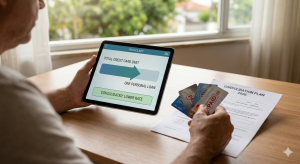
Curious which steps truly speed approval and protect personal data when someone wants a new payment tool?
This introduction shows how Canadians can complete a secure, guided request from choosing the right product to submitting paperwork and checking a decision in their account. It explains what a credit card is and why it matters for everyday purchases, travel bookings and building credit.
Readers get a clear view of required information, typical eligibility checks and helpful services such as identity verification, card lock and zero liability from Visa and Mastercard. The text also flags key benefits and rewards, plus common fees and conditions to watch before accepting any offers.
Short sections ahead cover eligibility, step-by-step submission, documents to have ready, and how account timelines and dates affect decisions. The aim is to help readers choose the right type of card and confirm their eligibility before they move forward.
Why Canadians choose to apply credit card online today
Many Canadians now finish a full credit card request from their phone or laptop in minutes. The process is guided, so people can compare offers, fees and rewards before they decide. Digital forms capture information quickly and cut down the time it takes to get a decision.
The move to digital channels also brings practical tools. Users can lock or unlock cards instantly through mobile banking. Banks present benefits and service details in one place, and proactive alerts help them track due dates and payments.
- Faster decisions: streamlined checks and document upload reduce delays.
- Greater control: card lock, fraud monitoring and real‑time alerts improve security.
- Convenient payments: options include mobile apps, automated payments, phone, mail, branch or ATM.
| Feature | What it does | Benefit | When it helps |
|---|---|---|---|
| Card selector | Matches needs to product | Saves time choosing cards | Before submitting an account request |
| Card lock | Instant disable/enable | Limits unauthorised use | If a card is lost or misplaced |
| Zero Liability (Visa/Mastercard) | Reverses fraudulent charges | Peace of mind for digital use | When unauthorised transactions occur |
| Consolidated offers | Side‑by‑side rewards and fees | Clear comparison | When choosing a rewards plan |
Check eligibility before you start
A quick eligibility check can reveal whether a person qualifies for the best offers and services. Confirming requirements first helps avoid revoked approvals or delays from mismatched information.
Income, residency, and credit profile considerations
They should confirm minimum income expectations, Canadian residency and that they are of legal age in their province. Lenders also review the applicant’s recent credit history and account activity.
Recent activity matters: late payments or high balances can reduce approval odds or lower limits. Knowing typical score ranges for approvals helps avoid multiple requests that may harm a report.
Primary vs. supplementary cardholders
Primary cardholders are responsible for the account and any balances. Supplementary cardholders can make purchases but do not hold primary liability.
Many issuers allow adding supplementary users at no fee on select products and let the primary set spending limits. However, some offers exclude individuals who were primary or secondary holders with the same issuer within the past two years.
- Check if certain transactions count toward rewards or promotional thresholds, since conditions vary.
- Confirm personal information matches verification checks to avoid extra documents or delays.
- Identify status (student, newcomer, self‑employed) to match cards designed for that profile.
| Factor | What to check | Why it matters |
|---|---|---|
| Residency & age | Proof of address and provincial majority | Legal eligibility and verification |
| Income & employment | Reported income range and employer details | Determines limits and program qualification |
| Recent account history | Open/closed accounts, late payments | Affects approval odds and offers |
apply credit card online: a simple step-by-step
A simple workflow helps people pick the best product, upload needed documents and finish a secure submission.
Select your card type
Start by matching goals to product. Choose cashback for everyday savings, rewards for flexible redemptions, travel for points redeemable on flights and hotels, or low interest to manage balances.
Gather documents and information ahead of time
Have government ID, employment details, income, housing costs and recent credit history ready. Using accurate information reduces delays and extra requests.
Complete the secure application and submit
Enter details carefully so verification checks match. Many firms use Interac digital identity verification services to verify documents from home and cut review time.
What happens after you click apply
Applicants often get an instant decision. If approved, they may receive a temporary number for digital wallets to make immediate purchases while waiting for the plastic to arrive.
- Review terms: accept the cardholder agreement and note fees and benefits before activation.
- Set up account tools: online banking, alerts and automated payments help prevent missed dues.
- If declined: expect guidance on next steps and reasons to improve eligibility.
| Step | What it does | When it helps |
|---|---|---|
| Select type | Matches spending to rewards | Before submitting |
| Verify ID | Speeds onboarding | Reduces time to first use |
| Activate | Enables full account access | After physical card arrival |
Information you’ll need for a secure application
Having key facts at hand speeds verification and reduces follow‑up requests. Collecting accurate details before starting helps the bank confirm identity and assess eligibility without delays.
Personal details and contact information
Provide legal name, current address history, phone number and an email address. These items let the lender match records and send time‑sensitive messages about the account or missing documents.
Employment, income, and housing costs
Report employment status, employer name, time in role and total income. Self‑employed applicants should use an average income figure and have recent statements if requested.
Include monthly housing expenses — rent or mortgage — since lenders use this to judge affordability and set an initial limit on the card.
Existing accounts and balances
List open accounts with current limits and outstanding balances. This shows overall exposure and payment behaviour, which affects approval decisions.
Most banks will ask consent to check bureau records. Ensuring the application matches bureau data avoids mismatches that slow the decision date.
- Digital verification: many issuers accept uploads and use Interac document verification to confirm government ID remotely.
- Two‑factor readiness: a working mobile number enables fraud alerts and secure logins from day one.
- Supplementary cardholders: have names and birthdates ready if adding family users now simplifies setup later.
| Required item | Why it matters | Typical supporting proof |
|---|---|---|
| Legal name & address | Identity match for account opening | Driver’s licence, utility bill |
| Employment & income | Determines repayment capacity and limits | Pay stub, tax return |
| Existing accounts & balances | Shows exposure and recent payments | Statements, current balances |
| Contact details | Enables time‑sensitive communications | Phone number, email |
Compare key features: cash back, points, and benefits
Look beyond headline rates to see how earn structures and included protections affect net value. Comparing cash back, points and insurance helps readers match a program to their spending and travel plans.
Earn cash back on eligible purchases and categories
Cash back cards return a percentage on everyday purchases. Some pay an annual credit on a set statement cycle. Others let holders redeem throughout the year.
Tip: seek category bonuses for groceries, restaurants or recurring bills to accelerate rewards and boost value.
Redeem points for travel, gift cards, and merchandise
Rewards cards convert points into travel, gift cards or merchandise. Flexible programs suit those who value travel perks or want a variety of redemption options.
Included insurance and purchase protection options
Many Canadian offers include purchase security and extended warranty insurance. These benefits can protect eligible items and often add a year to the manufacturer’s warranty.
- Consider annual fee against expected returns to check net benefit.
- Check whether cash-like transactions earn rewards — they usually do not.
- Review expiry rules, minimum redemption levels and whether supplementary cards share rewards.
| Feature | Typical benefit | Best for | Notes |
|---|---|---|---|
| Cash back | Percentage back on purchases | Everyday spending | May include annual credit; check cash back eligible categories |
| Rewards points | Points for travel, gifts, merchandise | Travel and flexible redemptions | Program rules affect value and expiry |
| Insurance & protections | Purchase security, extended warranty | Frequent buyers of electronics or travel | Often included with Visa and some premium cards |
| Fees & rates | Annual fee, interest rate | Those who carry a balance or want extras | Higher fees can be worth it if benefits exceed the cost |
Understanding rates, fees, and charges
Seeing how interest compounds over months makes it easier to plan repayments and avoid extra costs.
Purchase vs. cash advance rates
Banks set a lower purchase interest rate for everyday buys and a higher cash advance rate for withdrawals. For example, a purchase interest rate might be 19.99% while cash advances sit near 22.99%.
Annual fee and additional cardholder fees
Annual fee structures vary from $0 to premium levels. Some products waive the annual fee for extra users, while others charge per additional user. Confirm the fee for each added person on the account.
Balance transfer and other program charges
Balance transfers often carry a fee, such as 2% of the transferred amount (minimum $5). Other charges include foreign exchange and cash‑like transaction fees. These add to the cost of consolidating debt under a promo rate.
- Payments above the minimum are applied proportionately across interest groups, not to a chosen balance.
- Interest accrues daily; the longer a balance remains, the more it grows.
- Missing two minimum payments can trigger higher standard rates and extra charges on the account.
| Item | Typical example | Why it matters |
|---|---|---|
| Purchase interest rate | 19.99% | Affects ongoing cost of carried balances |
| Cash advance rate | 22.99% | More expensive for cash withdrawals |
| Balance transfer fee | 2% (min $5) | Impacts savings from promo offers |
Read each statement date and due date closely to keep the account in good standing and preserve any promotional rate in the program.
Intro offers and conditions apply: what to know
Introductory offers can add real value, but readers should check timing, exclusions and posting rules before relying on bonus rewards.
A common example is a 5% cash back bonus on the first $2,000 in eligible purchases within the first three months from the account open date. Eligible purchases exclude payments, cash advances, balance transfers, interest, fees and cash-like transactions.
Cash back may post in two parts: the bonus portion can arrive roughly seven months after the open date, while the regular portion posts on the program’s normal statement schedule. Knowing the payout date helps plan when rewards truly appear.
- Balance transfer promo: 0% for six months with a 2% fee (min $5); unpaid balance reverts to the higher cash advance rate after the promo ends.
- Keep payments current: missing two minimum payments in a row can cancel promos and trigger standard annual interest rates.
- Watch exclusions: some offers bar current or recent product holders (for example within two years) from eligibility.
| Offer | Typical window | Key risk |
|---|---|---|
| 5% cash back first | First 3 months | Exclusions and delayed bonus posting |
| 0% balance transfer | 6 months | Transfer fee and higher post‑promo rate |
| General promos | Fixed dates | Forfeiture if account not in good standing |
Balance transfers and consolidating debt
Consolidating high-interest balances onto a lower-rate account can cut monthly interest quickly. A transfer often helps when a short promotional rate meaningfully lowers interest and a realistic payoff plan fits the promo months.
When a transfer makes sense vs. a line of credit
Choose a transfer if the promotional rate covers the expected payoff period and the transfer fee does not erase savings. If payments will stretch beyond the promo months, a low-rate line of credit may cost less over time and avoid repeat fees.
Limits, processing, and payment allocation rules
Transfer requests depend on the new account’s cash advance limit and approved credit limit. Requests above available limit may be declined or partially processed.
- Common promo example: 0% for 6 months with a 2% fee (min $5); check if the offer allows transfers within the same bank family.
- Payments above the minimum are applied proportionally across balances by rate, so applicants cannot force a single balance to be paid first.
- Continue paying the original account until the transfer posts, then confirm the amount, fee, promo rate and expiry on the new statement.
| Action | What to check | Why it matters |
|---|---|---|
| Promo rate & expiry | Length of months and post‑promo rate | Determines payoff target and future charges |
| Transfer fee | Percentage and minimum | Reduces net savings |
| Available limit | Cash advance and approved amount | Limits the transfer size or causes decline |
| Payment allocation | How extra payments are applied | Impacts speed of paying down the transferred balance |
Security first: fraud protection and identity verification
A layered approach to verification and alerts reduces risk and speeds resolution when suspicious activity appears. Strong protections help keep an account secure while letting cardholders move quickly if something looks wrong.
Zero Liability policies from Visa and Mastercard protect users against unauthorised charges when reasonable precautions are taken. This reassurance covers many online and in‑store incidents and is a key benefit of responsible use.
- Real‑time fraud alerts by text, email or phone let the holder spot odd transactions fast on their account.
- Card lock in mobile banking blocks new charges immediately if a physical card is misplaced.
- Chip‑and‑PIN adds a secure step for in‑store purchases and cuts counterfeit risk for cards used in Canada.
- Interac document verification lets applicants confirm identity remotely during digital onboarding.
| Protection | What it does | Why it helps |
|---|---|---|
| Zero Liability (Visa) | Reverses unauthorised charges | Limits out‑of‑pocket exposure |
| Real‑time alerts | Immediate notice of suspicious activity | Enables quick action on the account |
| Card lock | Temporary block on new transactions | Prevent further charges while resolving |
If a card is lost or stolen, call the issuer right away and use the app to lock the account. For more detail on reporting and recovery, review the bank’s fraud guidelines. Keeping contact information current and never sharing a PIN are simple habits that reduce risk and speed help when questions arise.
Digital payments and everyday convenience
Modern payment services let users finish transactions in seconds while keeping card data hidden from merchants. This reduces friction at checkout and adds a layer of security for routine purchases.
Click to Pay for faster online checkout
Click to Pay saves stored details so shoppers do not type numbers for every purchase. When the Click to Pay icon appears, checkout moves faster and tokenization keeps the underlying card number private.
Mobile wallets: Apple Pay, Google Pay, Samsung Pay
Apple Pay, Google Pay and Samsung Pay enable tap-to-pay in stores and within apps. Enabling a wallet soon after approval lets the account be used immediately while the physical card arrives by mail.
- Tokenization and chip-and-PIN add protection during purchases.
- Some banks link cards to global money transfers and offer cash back if the balance is paid on time with no transfer fee.
- Digital receipts and app histories make tracking across the year easier.
- Combined with fraud alerts and card lock, wallets form a secure, convenient toolkit for daily payments.
| Feature | What it does | Why it helps |
|---|---|---|
| Click to Pay | Stores payment tokens | Faster checkout, fewer keystrokes |
| Mobile wallets | Tap-to-pay with tokenization | Protects card number at terminals |
| Digital receipts | Transaction record in app | Budgeting and dispute support |
Managing your account after approval
Approval is only the start; good account habits protect promotional rates and maximise cash back.
Setting up online banking and automated payments
After approval, set up online banking and link a bank account for quick payments. Automated payments can ensure the minimum payment posts by the due date every month.
Tip: enable two‑factor authentication and text alerts to catch suspicious activity fast.
Understanding your statement date and minimum payment
Review the statement date and due date so the grace period is preserved. Paying the full balance by the due date avoids interest on new purchases.
If carrying a balance, pay more than the minimum to reduce interest and repay sooner. Missing minimum payments can cancel promos and raise the rate charged.
Tracking rewards and annual cash back credits
Use the rewards dashboard in the account portal to watch monthly earnings. Some programs post regular rewards on each statement while bonus amounts may appear later.
Note: certain cash back programs credit an annual cash back on a set month, such as the January statement. Adding supplementary users can speed up rewards, but the primary remains responsible for the account.
- Make payments via mobile app, online banking, phone, mail, branch or ATM.
- Set alerts for statement issue and due dates to avoid late fees and interest.
- Plan paydown of promotional balances before expiry and check how payments are allocated across rate groups on the statement.
| Action | Why it matters | When to do it |
|---|---|---|
| Enable automated payments | Prevents missed minimums | Immediately after approval |
| Review statement date | Preserves grace period and avoids interest | Each month |
| Monitor rewards | Maximises cash back and bonus tracking | Monthly and annually |
Read the fine print: agreements and program terms
Before activating a new account, review the legal documents that govern use and rewards. These PDFs explain how the program works, which rates apply, and what fees or charges may appear over time.
Cardholder agreement, summary of rates and fees, and insurance certificates
Cardholder agreements lay out responsibilities, dispute steps and how the institution may update conditions. Reading this helps cardholders spot limits, payment order rules and cancellation terms.
Summary of rates and fees shows the purchase rate, cash advance rate, annual fee and any additional cardholder fees. Use it to compare true costs between offers and to plan payments that avoid surprise charges.
Insurance certificates list coverage such as purchase security or extended warranty, plus exclusions and claim steps. Knowing these rules in advance speeds a claim and prevents unexpected denials.
- Program terms explain which transactions earn rewards and when statement credits post.
- Conditions can change; keep the latest PDFs for reference and dispute support.
- Retain acceptance dates and promotional materials in case questions arise later.
| Document | What it contains | Why it matters |
|---|---|---|
| Cardholder agreement | Account rules, dispute process, update clauses | Defines rights and obligations for cardholders |
| Summary of rates & fees | Purchase/cash advance rates, annual fee, other charges | Shows real cost and how payments affect balances |
| Insurance certificates | Coverage details, exclusions, claim steps | Explains protection and how to file claims |
If anything is unclear, contact support with specific questions and reference the page or section in the PDF for a faster resolution.
Ready to apply online? Get started with a secure Canadian application
Start a secure, guided application to compare credit card options and choose the mix of rewards or cash back that suits everyday purchases.
The process confirms eligibility, gathers required information and usually returns a fast decision. Review the annual fee, interest rate and any other fee details up front to decide between no‑fee and premium options.
Digital identity verification lets applicants add the new card to a mobile wallet and use it while the physical plastic arrives. Program terms show relevant months, dates and when statement credits or bonus payouts post.
After approval, set automated payments and alerts, use the bank’s portal to track rewards and statements, and rely on tools like card lock and Zero Liability for secure use across Canada. Begin now to take advantage of current offers and start earning value on routine purchases.